
What AI means for your digital infrastructure in 2026: the top 6 AI use cases in enterprise networking and security
- Ciaran Roche
The buzz around AI is deafening and shows no signs of fading. As digital transformation accelerates, innovative solutions supported by emerging technologies and AI are crucial in driving the security, growth, and transformation that modern enterprises need to thrive in today’s competitive business landscape. However, to succeed within the rapidly evolving AI landscape, business leaders must cut through the buzz and prioritize AI investments that directly align with strategic business objectives while thoughtfully integrating these technologies into their digital architecture.
According to a recent Gartner AI survey: “57 percent of CIOs said that they are tasked with leading their organization’s AI strategy, but to define and deliver on AI outcomes, you must first understand which race you’re running — and at what pace.”
At the same time, they must also balance risk management while maintaining a strong cybersecurity posture — no easy feat. In fact, CIO Magazine reports that although 80 percent of organizations plan to increase their AI investments, many CIOs are unsure where to begin, with almost a third reporting a lack of a clear vision as a major obstacle.
Yet, CIOs who are already adopting AI-ready solutions are seeing results through AI-driven solutions that enable load balancing and real-time threat responses, allowing enterprises to anticipate bottlenecks and protect against cyber risks. CIOs are the orchestrators of innovation and with the power of AI, they are revolutionizing the businesses they lead. These astute leaders recognize that by aligning infrastructure upgrades with AI and strategic business goals, their enterprise can fully leverage AI’s potential and remain competitive in a digital-first world.
“We are entering the era of artificial intelligence – an era that will change everything.”
- Blake Irving, former Executive Vice President, Chief Product Officer Yahoo!
“The playing field is poised to become a lot more competitive, and businesses that don’t deploy AI and data to help them innovate in everything they do will be at a disadvantage.”
- Paul Daugherty, Chief technology and innovation officer, Accenture
“AI is going to be the key to understanding and solving many of the world's most complex problems.”
- Satya Nadella, CEO of Microsoft.
Before you can fully leverage AI, acknowledge the downsides
AI can be a key enabler of transformation, but this emerging technology also brings inherent risks. Last year, Gartner identified AI-enhanced malicious attacks and AI-assisted misinformation as the top two emerging risks to enterprises, highlighting only some of the key threats AI presents.
CIOs must recognize and address these AI-related risks that can negatively affect their enterprise and also work toward identifying any vulnerabilities surrounding any AI integration. Otherwise, various AI-related blunders can occur like the Microsoft-powered chatbot MyCity that erroneously encouraged business owners to break the law or when Salesforce increased human handoffs from enterprise AI agents up to 5 percent from 1 percent to achieve better customer outcomes.
AI-related mishaps such as these are expensive, costing not only the price of the integration of AI-powered solutions, but operational downtime and potentially a business’s reputation. These challenges affect businesses of all sizes and across all sectors, but CIOs have even more to worry about in terms of AI-associated risk, including privacy concerns, increased risk related to third-party platforms and AI-generated cyber warfare targeted enterprises.
The advantages of AI + intelligent infrastructure for digital transformation
With the growing demand surrounding a modern digital backbone to support AI and emerging technologies, the number of enterprises navigating this complex journey is growing. The IDC reports: “For the first time ever, we see that the majority of enterprise organizations (53 percent) have an enterprise-wide digital transformation strategy, a 42 percent increase from just two years ago.”
Additionally, Harvard Business Review asserts: “Without a well-structured architecture, AI integration can falter – limiting information flow, collaboration, and scalability.” To facilitate successful digital transformation and AI integration, enterprises must ensure that their IT infrastructure, platforms, and networks enable modern technology and solutions instead of hindering them. CIOs who successfully integrate AI can transform enterprises. This powerful lever can automate routine tasks, analyze data, and drive innovation with minimal disruption. However, enterprises must include an AI strategy as part of their digital framework. CIOs prioritizing these digital strategy aspects will position their organization to seize new opportunities.
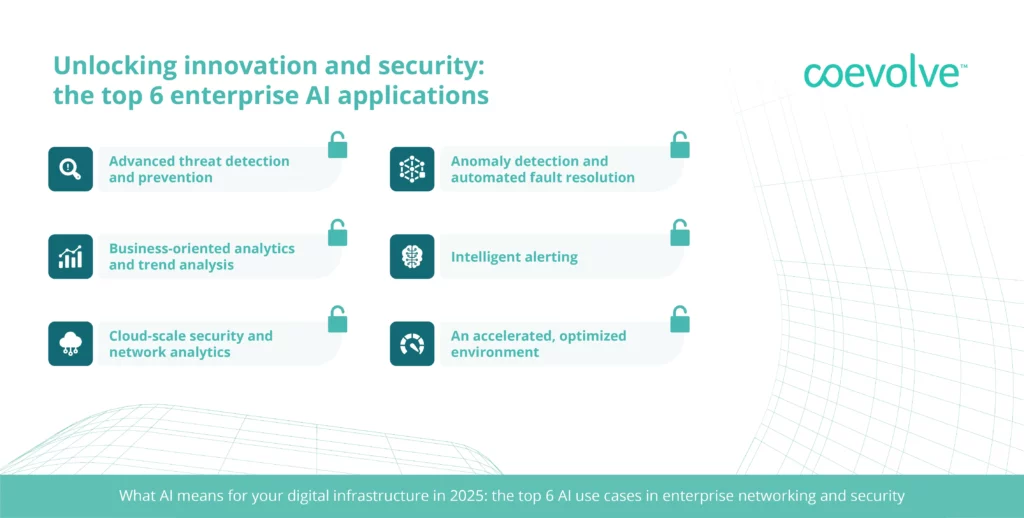
Unlocking innovation and security: the top 6 enterprise AI applications
AI is extremely versatile, and when tailored to meet an enterprise’s demands, it can bridge the gap in various areas, like employee skill sets, automating tedious tasks, and, most critical for many enterprises, AI-supported cybersecurity. More than simply better automation, AI unlocks entirely new functionalities that can dramatically improve networking and security. Below, we look at the top 6 AI use cases for your enterprise:
1. Advanced threat detection and prevention
AI empowers IT teams to spot and stop threats more effectively by analyzing data across all layers of their digital ecosystem. To put the rapid change in this area into perspective, Amazon detects an average of 750 million cyber threats daily, up from 100 million, largely due to the use of AI by cybercriminals, underscoring that AI-powered threat detection is urgently required for businesses.
2. Business-oriented analytics and trend analysis
AI unlocks new information for IT leaders, providing new performance data that offers greater clarity on operational efficiency. A McKinsey and Co. survey revealed that organizations’ use of AI has accelerated markedly in the past year, with most leveraging AI in an average of three functions. Also, 50 per cent of organizations say data scientists are in high demand, indicating the use of AI in analytics is on the rise.
3. Cloud-scale security and network analytics
AI enables cloud-scale security and network analytics, allowing IT leaders to improve vendor management and compare peer performance. According to Palo Alto Networks, 64 percent of organizations experienced more data breaches in the past 12 months, highlighting the need for AI-driven cloud security solutions.
4. Anomaly detection and automated fault resolution
AI can identify unusual network patterns and fix issues automatically by isolating “essential data” to resolve problems faster. An example is HighRadius, who employs AI/ML-powered anomaly detection to reduce false positives over time, streamlining the alerting process. This can not only minimize downtime but maintain system reliability and ensure rapid response to potential threats or failures before they impact users.
5. Intelligent alerting
AI-generated analysis and integration enable timely alerts, providing helpful insights and update notifications to work smoothly with current tools and systems. Also, AI-driven alerting systems reduce alert fatigue and excessive alerts to improve efficiency by prioritizing, categorizing, and potentially resolving incidents proactively. Forbes reports that security professionals admit keeping up with alerts is challenging, with nearly half of incoming alerts going unaddressed, highlighting the critical importance of addressing this area.
6. An accelerated, optimized environment
AI fosters optimized operations and a digital ecosystem that avoids errors and failed paths to improve end-user performance. Consider how Cloudflare secured its largest-ever $100 million contract, thanks to its AI-integrated Workers developer platform, which highlights the rising demand from enterprises for AI-enhanced cloud services that deliver scalable, high-performance AI applications at the edge.
The future of AI-powered IT infrastructures: smarter, faster, and more secure
CIOs stand on the precipice of change enabled by digital transformation and AI, but they must be cautious. They must stay the course and not get distracted by the latest and greatest innovative technology.
When applied to your digital backbone, the power of AI is undeniable. It reveals an increased level of innovation and optimization never realized before. In order to realize AI’s potential, however, CIOs must effectively create a clear strategy for adopting AI-powered IT infrastructures, transforming their enterprises into secure, future-ready innovation machines capable of overcoming any challenges on the horizon.
To learn more, contact us or read more about how CIOs can leverage AI to enhance network security.