

Cloud Networking
Extending your network to the public cloud
What is cloud networking?
Over the past few years, cloud networking has emerged as one of the most significant changes in the industry, resulting in a complete change in network topology. Initially, enterprises viewed cloud networking as a mere extension of their data centers, but as more applications were cloudified, the requirements grew.
With more capacity, resilience, and diversity being demanded, we’ve seen a shift in the ‘center of gravity’ of enterprise networks – from on-premises to the public cloud. This has created the opportunity to deploy elastic, resilient networks that are cost-efficient, scalable, and perform to the standards required for today’s applications.
In simple terms, cloud networking is the road or pathway that connects users to the cloud resources they depend on, whether those resources live in a public cloud, a private cloud, or across multiple cloud environments simultaneously. Learn more about how Coevolve helps enterprises plan and implement cloud network architecture.
How cloud networking supports enterprise connectivity
Cloud networking has become an integral component of enterprise environments and plays a critical role in business performance. With cloud providers taking ownership of the virtualized infrastructure, they transfer the responsibility of building and maintaining the network from enterprises. This means that enterprises no longer need to build or maintain their own network infrastructure.
This shift has been a driver for many enterprises to transition to a more cloud-centric approach. By deploying applications and workloads to a virtualized network infrastructure and integrating Software-Defined Wide Area Networks (SD-WAN) at the edge, enterprises can retire their expensive Multiprotocol Label Switching (MPLS) network, servers, and on-premises data center.
In practice, cloud networking enables users to securely access applications, data, and services hosted in cloud environments. Rather than relying solely on physical network infrastructure, organizations use cloud-based networking services to connect users, locations, and workloads across public, private, and hybrid cloud environments.
This approach brings the flexibility, scalability, and visibility needed to support business operations today. Read how SD-WAN and cloud networking work together in practice.
Key benefits of cloud networking for enterprises
Cloud networking has quickly become the new normal for enterprise networks leading to better business performance through the following:

Enhanced access to applications
Cost savings
Increased agility
From a more elastic network that can ramp up and down when required
Flexibility
The ability to scale with the business

Cloud network security challenges: what enterprises need to know
Cloud networking introduces security challenges that traditional on-premises models were not designed to handle. When users connect from home offices, branches, and mobile devices to workloads spread across multiple cloud environments, the concept of a fixed network perimeter breaks down.
Key security considerations for enterprise cloud networks include:
- Shadow AI and unsanctioned SaaS use: employees accessing unauthorized AI tools or cloud apps create visibility blind spots that standard security tools miss.
- Data leakage risks: sensitive data passed into public AI models or cloud services can expose enterprises to regulatory and compliance risk.
- Inconsistent policy enforcement: applying consistent security policies across users, devices, and cloud apps requires an architecture built for distribution.
- Expanded attack surfaces: cloud APIs, AI models, and multi-cloud connectivity all introduce new vectors that need to be managed.
These challenges highlight how a cloud network architecture that embeds security in its architecture, rather than being applied afterwards, is the only sustainable approach.
Coevolve’s guide to AI and network security explores how the network itself can become the control plane for enforcing governance, visibility, and data-path authority as AI adoption scales.
Cloud networking use cases for enterprise IT
Cloud networking supports a range of enterprise scenarios. Common use cases are:
Supporting hybrid and remote work
With employees increasingly connecting from home offices and remote locations, enterprise networks must provide secure, reliable access to cloud-hosted applications regardless of where users are located.
Cloud networking helps reduce reliance on centralized office-based infrastructure by enabling direct, policy-driven access to applications and services in the cloud. Our article on why enterprises are prioritizing cloud networking covers how remote access is reshaping network requirements.
MPLS retirement and WAN modernization
Multi-cloud and hybrid cloud adoption
As enterprises distribute workloads across multiple cloud providers, cloud networking provides the framework to connect these environments.
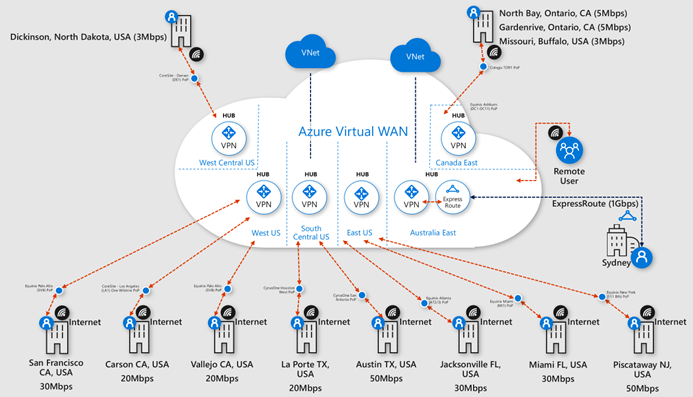
Services like Azure Virtual WAN offer an alternative backbone to traditional telco networks, simplifying connectivity between branch locations, cloud workloads, and remote users while providing centralized management and routing. Coevolve is a certified Azure Networking MSP partner with experience in designing, deploying, and managing these environments.
Why enterprises trust Coevolve for cloud networking
With enterprises facing the common challenge of supporting users from any location, cloud networking is a necessity and no longer gives enterprises a competitive edge.
Working with a strategic partner like Coevolve can ensure better business outcomes and deliver superior results by acquiring the knowledge and expertise of industry professionals from a cost perspective or performance perspective.
Our cloud services are driven by a solution-orientated approach, where we first will take the time to understand your business, its requirements, needs, and capabilities. From here, we are able to build a solution alongside your enterprise tailored to your needs.
Coevolve has been designing, deploying, and managing cloud networking environments since 2018. As a certified Azure Networking MSP partner, we deliver professional and managed network services across Microsoft Azure environments, including Azure Virtual WAN.
Learn more about how Coevolve approaches managed network services, or see the enterprises we have worked with across different industries.
Cloud networking FAQs
What is the difference between cloud networking and traditional networking?
How does SD-WAN relate to cloud networking?
SD-WAN operates at the edge of the enterprise network and determines how traffic is routed to cloud applications and services, making it a critical component of a high-performing cloud network. Learn more on how SD-WAN fits into a multi-cloud network.
Is cloud networking secure?
Cloud networking can be highly secure when the right architecture and policies are in place. A security-first approach, like SASE and applying zero-trust principles, ensures that policies are enforced consistently wherever users and workloads are located.
How much does cloud networking cost?
Why should enterprises work with a managed service provider for cloud networking?
Cloud networking environments can introduce significant complexity in connectivity, routing, operations, and security. A specialist managed service provider can help organizations design, deploy, and manage these environments effectively.