
Building a modern digital infrastructure: high-level strategies for CEOs facing IT challenges, unreliable connectivity and tech debt
- Ciaran Roche
Despite several senior executive roles having a seat at the table within the modern organization, it is the CEO who is ultimately responsible for business performance, including reliable connectivity and digital transformation initiatives. Dubbed digital-value guardians by McKinsey and Co., CEOs often drive transformation within the broader organization, but they must work alongside their key IT leaders as they review vendors and pitch new solutions to boards to secure investments.
During the vetting process of these new solutions, CEOs must monitor their technical debt carefully – i.e. just how much they are investing in the plethora of IT solutions out there, as it all adds up quickly. Forrester predicts that by 2026, 75 percent of executive leaders will face increased tech debt -outdated or inefficient IT systems that hinder innovation – reaching moderate to high levels of severity, driven by the adoption of emerging technologies like AI. The report indicates that this steep rise in cost will significantly be exacerbated by legacy IT infrastructures unable to keep up with emerging technologies, the rapid development of AI solutions, and the many other IT applications out there.
In a rapidly changing tech environment, legacy IT architecture often cannot coexist seamlessly with modern solutions, putting businesses at high risk. According to Forbes, 70 percent of data breaches occur in organizations that run their IT using legacy systems.
Businesses will fail if their legacy systems let them down, and it is up to the CEO to prevent this from happening. With executives standing on shifting sand, as companies experience a record-high executive turnover – from 7-13 percent in 2024, redundancies included – they must not only ensure their business is competitive but they themselves are. Though the role of CEOs continues to evolve, what remains the same is that CEOs must ensure their business remains competitive, requiring risk-taking (calculated!) to drive transformation across their business, but most critically in their technology stack and digital infrastructure.
CEOs must confront key IT challenges that can impact business success
In today’s digital world, where the success of a business is closely tied to the actions of its leadership, CEOs are under constant scrutiny. A single misstep – whether reputational or strategic – can have serious consequences, making adaptability and sound judgment more critical than ever. CEOs who acknowledge the significant value their company will gain with a redesigned digital infrastructure will secure their position in the industry as digital visionaries, allowing them to solve their connectivity and digital transformation challenges.
In terms of connectivity, outdated legacy infrastructure challenges include compatibility, integration complexities, security vulnerabilities, disruption to existing processes and cost. Additionally, CEOs will face various challenges tied to outdated legacy infrastructures stemming from pain points such as lack of resources, budget, technology migration and debt management, and team skillsets. They also must work to change the narrative by boards that see network and security infrastructure as ‘money pits’.
CFOs and boards must be taken on the digital transformation journey, aligning business objectives to digital infrastructure improvements. During this process, they will recognize that IT infrastructure is the foundation to thriving businesses, resulting in their buy-in.
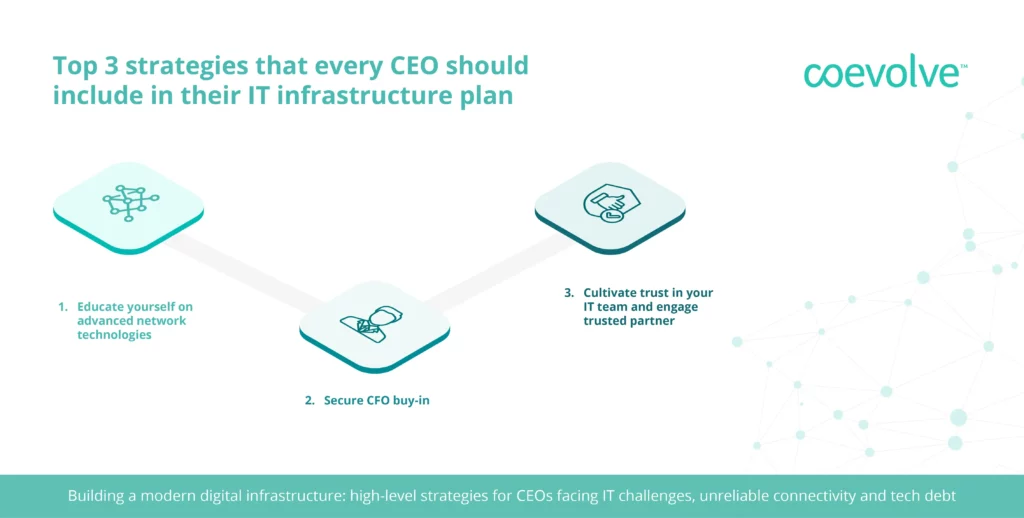
The top 3 strategies to support building a future-proof digital infrastructure
Much like an architect designing a city of the future, CEOs can act as architects of change, designing the way forward and enabling their enterprise to be innovation-ready and capable of integrating critical cybersecurity solutions while maintaining reliable connectivity. To overcome common objections, the CEO should review their current digital infrastructure, network, and network security, as well as connectivity maturity ensuring they are closely aligned with their CIOs and CTOs to develop the best options to move forward. These areas deserve urgent attention, as each has become increasingly critical to a company’s success and can help or hinder in areas like strategic oversight, risk management, innovation, and crisis management. Below are the top strategies that every CEO should include in their IT infrastructure plan:
1. Educate yourself on advanced network technologies
By deploying cutting-edge solutions like automation, SD-WAN, cloud-first strategy, CEOs can work toward optimizing network performance, reducing latency, and simplifying integration with cloud and AI-driven applications. By embracing these innovations and tailoring them to your business, CEOs can drive transformation across the enterprise with heightened agility and robust cybersecurity.
“Mission Australia is a perfect example of how to leverage a strategic partner successfully. Coevolve not only empowered their leaders with critical knowledge of how to improve their networking but ultimately, helped them deliver a robust, cost-effective network solution that can enable frontline workers in highly remote areas. By leveraging next-generation technologies, Mission Australia can expand its reach to even the most remote communities - a win-win for the business and its employees.”
- Tim Sullivan, Co-Founder and CEO, Coevolve.
2. Secure CFO buy-in
Gartner has found that 77 percent of CFOs will increase technology budgets in 2025 but in order to secure a digital infrastructure modernization budget, CEOs must show the value of this expense. Draft a cost analysis with ROI benchmarks, highlighting the cost of legacy infrastructure that includes maintenance and holding back innovation. Also, be sure to be transparent that IT infrastructure needs continuous maintenance and fine-tuning.
3. Cultivate trust in your IT team and engage trusted partners
Upgrading your digital infrastructure will require a mindset adjustment to get ready for any challenges or disruptions that may take place. Have a plan and ensure you foster a collaborative team culture, one that is willing to take calculated risks to gain the best result, such as adopting appropriate next-generation solutions and recognizing traditional telecommunication offerings are no longer serving them. Engage trusted partners like MSPs that can lend their expertise to support the creation of environments capable of integrating emerging technologies effortlessly.
Unlocking growth with MSP Support for seamless IT management = significant gains
Building a modern digital infrastructure is no longer nice but a business imperative in today’s fast-paced, demanding digital world. CEOs face numerous IT challenges, including unreliable connectivity, a lack of resources and skills, a shaky IT foundation incapable of holding up another 10 years, technology migration, managing ‘technology debt’ and outdated legacy infrastructure. But our high-level strategies can support those tackling these challenges to unlock growth and significant gains.
Modernizing IT infrastructure is critical for businesses grappling with unreliable connectivity and outdated systems, but specialized partners like Coevolve can help you identify gaps and strategically plan how to optimize underperforming areas.
With customizable solutions, Coevolve can enable seamless integration, boost operational flexibility, align your IT systems with strategic objectives and enhance control for IT teams. Learn more about how we can help you overcome your specific IT and connectivity challenges to achieve a robust, scalable infrastructure that can accelerate long-term growth and innovation. To learn more about Coevolve, contact us today.