

- Claire McRobert
In this fast-paced digital world, the modern CIO can’t afford to take their eyes off the ball. Not only must they embrace new technologies like AI, but they must proactively anticipate and counteract the unprecedented increase in cyber threats – a challenge that AI itself is amplifying.
With new AI-driven cyber threats emerging almost daily, leaders must continuously monitor and refine their network security strategies. For CIOs aiming to future-proof their businesses, leveraging cutting-edge security practices supported by a robust zero-trust framework that incorporates AI will become key.
Key Takeaways
- AI is reshaping both sides of cybersecurity, acting as a powerful defense tool while simultaneously enabling more advanced and scalable cyberattacks.
- Zero-trust is fast becoming a baseline expectation in modern network security, shifting organizations from perimeter-based defense to continuous verification across users, devices and networks.
- The combination of AI and zero-trust enables a more intelligent, adaptive security model, enhancing threat detection, accelerating response speed, and strengthening overall resilience.
- Gaps in AI security and risk governance are leaving organizations exposed, despite rapid enterprise uptake of generative AI technologies.
- CIOs must take a proactive, strategy-led approach, establishing zero-trust first and layering AI capabilities to maximize security outcomes.
- A well-executed AI-powered zero-trust strategy delivers both security and business value, including increased productivity, reduced costs, and greater operational flexibility.
According to McKinsey and Co., AI and generative AI (GenAI) are revolutionizing the business landscape. The firm marked 2023-24 as the period the world discovered GenAI, while 2026 is the year enterprises where are at risk if they don’t adapt – and fast. In fact, roughly 71 percent of enterprises are using GenAI in at least one business function.
Today, enterprises face a growing urgency to better manage their expanding data requirements and keep pace with evolving regulatory changes. This is driving rapid adoption of zero-trust frameworks supported by AI. Without this, businesses risk losing their competitive advantage and becoming more vulnerable to sophisticated, AI-driven breaches and attacks.
This urgency is not just theoretical; it’s reflected in broader government and industry action. For example, the U.S. Department of Defense has directed enterprise-wide implementation of Zero Trust Architecture by Fiscal Year 2027, reinforcing a shift toward continuous verification, identity-centric security, and resilient architectures built for increasingly AI-driven threats.
At the same time, according to McKinsey & Company, cybersecurity is moving toward an “agentic AI” model, where AI systems are embedded across the security stack and operate at machine speed. Adoption of AI agents is expected to double in the next three years, with 35 percent of organizations expecting them to replace tier-one SOC analysts and nearly half anticipating full integration across their cybersecurity infrastructure.
AI: a help and a hindrance
AI has vast cybersecurity potential, but it is a serious threat when applied by malicious actors. Enterprises are more vulnerable than ever, with AI-powered cyberattacks reporting a surge of 89 percent as breakout time falls to 29 minutes.
IT leaders are increasingly concerned, with security and risk cited as the top barriers to scaling agentic AI, according to McKinsey and Co. Despite this heightened threat landscape, only around 20 percent of companies have adopted risk policies for GenAI.
As the cyber landscape continues to shift, CIOs and IT leaders often struggle with where to begin and lack clear visibility into the measurable value these emerging strategies can deliver. This uncertainty leads to a critical question: what are the advantages of AI and zero-trust when applied to effectively enhance an enterprise’s network security?
Zero-trust benefits and integrating AI for a supercharged security strategy
Zero-trust and AI have emerged as a powerful duo in defending against cyberattacks, providing enhanced security that neither can accomplish alone. Zero-trust specifically is becoming a baseline in any cyber framework, and for good reason. The U.S. Cybersecurity & Infrastructure Security Agency indicates that zero-trust promotes benefits such as:
1. Productivity
Zero-trust can improve productivity by reducing unnecessary access friction while maintaining strong security controls. By automating verification based on user identity, organizations can minimize delays associated with over-permissioned systems or manual verification processes. When implemented effectively, this streamlined access model enables employees to work more efficiently without compromising security.
2. Enhanced end-user experiences
By enabling secure, consistent access across devices, locations, and networks, zero-trust creates a smoother and more reliable user experience. Employees can securely connect to the resources they need without complex VPNs or repeated disruptions, which is particularly valuable in hybrid and remote working environments.
3. Reduced IT costs
Zero-trust can reduce long-term network and security costs by replacing legacy security infrastructure (firewalls, VPNs) and minimizing the likelihood and impact of security breaches. Fewer and more contained breaches also mean lower remediation costs, less downtime, and reduced financial and reputational damage. Additionally, automated, policy-driven access controls and monitoring decrease reliance on manual processes.
4. Flexible access
Modern enterprises require flexibility, and zero-trust supports this by enabling secure, consistent access across devices or locations. Whether employees are working remotely, travelling, or operating across multiple regions, zero-trust ensures employees can work securely wherever they are without restricting business agility.
5. Bolstered security
At its core, zero-trust strengthens network security by enforcing verification of every user, device, and connection. This approach reduces the attack surface and limits lateral movement within networks. As a result, even if a breach occurs, its impact is contained and controlled more effectively, reducing the likelihood of widespread compromise.
Key benefits of a zero-trust security approach
Benefit | Impact on the organization |
Productivity | Automates access by ensuring users only reach what they need based on user verification, reducing friction and improving operational efficiency. |
Enhanced end-user experience | Delivers more secure and consistent access across devices and locations without reliance on legacy security infrastructure or repeated authentication disruptions. |
Reduced IT costs | Minimizes risk and operational overhead, reducing downtime, remediation costs, and manual IT workload through automation and policy-driven controls. |
Flexible access | Supports hybrid and remote working by enabling secure access from any location or device without limiting business agility. |
Bolstered security | Continuously verifies users, devices, and activity to reduce attack surfaces and limit lateral movement, helping contain threats through strict access control. |
A word of caution: Zero-trust is nuanced. It is not a product that inserts itself seamlessly into existing network infrastructure.
Enterprises need to clearly understand:
- who needs access to what applications in their organization
- write the restrictive policies required that only allow necessary traffic flows
A zero-trust strategy can be more challenging to adopt, but when combined with AI for policy analysis and anomaly detection, it adds another highly evolved layer of protection. Ernst & Young (EY) assert that “the use of AI in cybersecurity isn’t hype” and that AI can automatically detect various types of attacks quickly with roughly 92 percent accuracy.
How does AI complement a zero-trust approach?
In a nutshell, zero-trust elevates visibility over the entire organization, while AI reduces human error and enables automation of risk detection. Additionally, here are five top benefits of a zero-trust approach that are motivating CIOs to move towards an AI-powered strategy for zero-trust.
The top 5 benefits of a combined AI and zero-trust approach
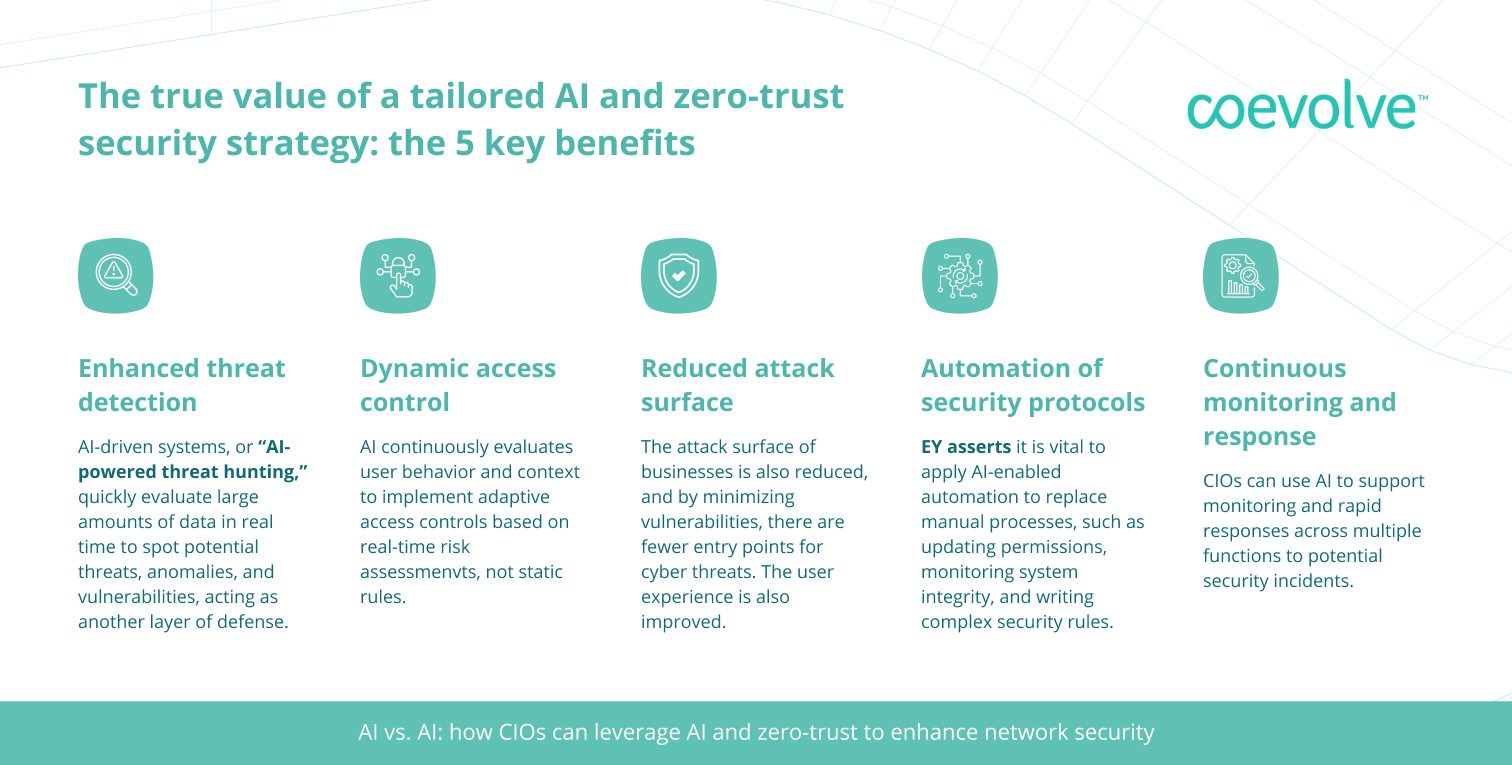
Each of these benefits is critical to integrating a comprehensive AI and zero-trust framework. In addition, here’s our advice for harnessing these innovative solutions to ensure success.
Advice for a winning AI and zero-trust strategy
There are several benefits to implementing an AI-powered zero-trust cybersecurity framework. It not only delivers quick wins but also ensures robust network security that is capable of withstanding the anticipated new wave of GenAI attacks.
Combining zero-trust and AI can enhance your security posture. However, enterprises must adopt a shared responsibility approach to security, extending from the office to our relationships with third-party providers, regulators, peer organizations, and so on.
To ensure you manage your zero-trust implementation effectively, we recommend that you first make zero-trust the foundation to simplify access. Following this, it is critical to integrate the new methodology with existing security practices and to iron out any bugs.
Lastly, a trusted partner, like Coevolve, can help you minimize disruptions during this process. Lean on our expertise at Coevolve to ensure a successful integration, resulting in a future-proof network security posture.
Table of contents
FAQs
What is AI-driven network security, and why does it matter to CIOs?
AI-driven network security leverages AI to detect, analyze, and respond to cyber threats in real time. When compared to traditional security, it enables faster, more proactive defense at scale, making it essential to maintain resilience, reduce risk, and protect operations.
How does a zero-trust framework improve cybersecurity?
A zero-trust framework improves cybersecurity by enforcing user verification for every user and device, regardless of location. This reduces the risk of unauthorized access, limits lateral movement across networks, and enables continuous monitoring of network activity.
Why is combining AI with zero-trust more effective than using either alone?
AI and zero-trust complement each other by combining access control with intelligence to boost outcomes. Zero-trust provides user-based access and full network visibility. AI enhances threat detection via automation, while reducing reliance on manual handling.
What are the main challenges of implementing AI and zero-trust in an organization?
The biggest challenges include defining clear and granular access policies, integrating new frameworks with existing infrastructure, and managing deployment at scale. When combined with AI, zero-trust brings issues with data quality, governance, and skills gaps.
Is AI a threat to cybersecurity as well as a solution?
Yes, AI is a threat and a solution to cybersecurity. AI can strengthen your cybersecurity strategy via automation and advanced detection, but it is also favored by malicious actors in sophisticated cyber-attacks. Organizations must urgently adopt AI-powered defenses.