
The Top 5 Innovations Shaping the Future of Digital Infrastructure (2026 Update)
- Ciaran Roche
Modern networks have evolved beyond acting as a pathway to connectivity to become critical enablers of productivity, revenue generation, and customer satisfaction, leading IT leaders to depend on them as a strategic asset. Yet, Forrester has warned that the complexity of enterprise networks has soared by two orders of magnitude (100 times better) from a decade ago, driven by the injection of multi-cloud and hybrid cloud networks, the integration of networking solutions by business partners, and zero-trust frameworks.
The erratic pace of IT change doesn’t allow for CIOs to merely stay informed about the latest advancements; they must also navigate the complexities of determining when, where, and how to integrate groundbreaking technologies into their digital infrastructures. In today’s hyper-connected world, seamless connectivity supported by a robust digital backbone not only supports business operations, communication, and reliable access to cloud-based applications but is the litmus test for success.
When considering the urgency of modernizing IT infrastructure, the stakes are high– Forbes reports that 70 percent of data breaches occur in organizations relying on legacy infrastructure and systems. Meanwhile, Gartner estimates that unplanned downtime costs businesses around $5,600 per minute, highlighting how costly weak connectivity can be.
Digital transformation is accelerating, yet it presents challenges such as cybersecurity issues, IT skills gaps, unreliable networks, poor connectivity, seamless data flow, and the rise of AI. With the global AI in networks market poised for explosive growth, reaching approximately USD 192.4 billion by 2034 (up from USD 15.3 billion in 2025), this surge highlights a critical shift: digital infrastructure won’t just be a key component of business strategy – it will be the foundation upon which success is built.
Digital transformation requires investments in IT infrastructure
Digital transformation cannot be achieved without IT infrastructure modernization. CIOs must increase strategic investments in their legacy infrastructure– not only as an investment in an enterprise’s future but one that can unlock significant cost savings. According to CFOtech: “Finding opportunities for monetary savings offers the benefit of reducing costs, but more importantly, it enables a reallocation of budgets towards innovation projects.”
The same report suggests that to help offset the modernization of IT infrastructure; there are various ways companies can realize cost savings, like optimizing automation and reducing tech debt, which often can be traced to the costs of legacy infrastructure.
According to Forbes, organizations often spend up to 80 percent of their IT budgets on maintaining legacy architectures, underscoring the critical need to modernize to free up the budget to spend in other key areas.
Thriving among digital disruption
As digital transformation accelerates, so do the headaches. For CIOs and IT leaders, staying ahead of digital disruption is no longer optional but essential. Understanding the threats and uncovering the potential of innovation in terms of digital transformation and achieving business goals will be key to navigating this fast-evolving landscape – and securing future connectivity in a hyper-connected world.
With that in mind, here are the top five innovations driving smarter, faster, and more connected networks.
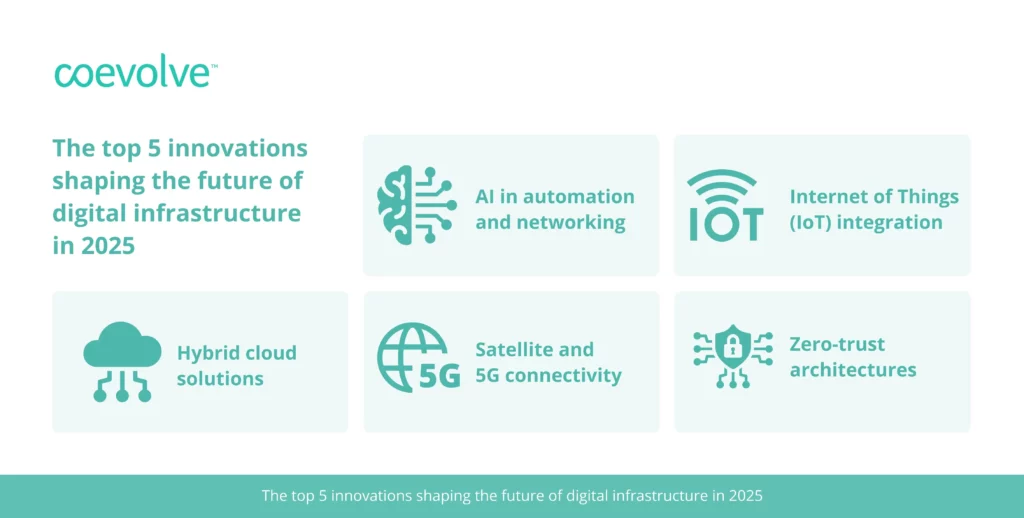
1. AI in automation and networking
AI is revolutionizing network management by making it intelligent. It can provide insights across the various IT domains (e.g., application, security, infrastructure, etc.), streamline operations, boost network reliability, automate routine tasks, and enable proactive issue resolution, which goes beyond regular anomaly detection to analyze data in real-time to predict and prevent issues before they arise resulting in avoiding costly downtime and ensuring a seamless user experience.
Furthermore, AI powers business-optimized networks, aligning network components and subsystems with overarching business goals and strategies. Armed with actionable insights at the business application layer, empowered IT leaders can now make informed decisions that enhance network performance, support business objectives, and, ultimately, drive business success. Business Wire reports that 98 percent of networking professionals now believe that AI and automation are essential for network operations, with many organisations planning a significant increase in spending to keep pace with digital complexity.
2. Internet of Things (IoT) integration
IoT is a mechanism that enables innovation and scalability by seamlessly connecting devices across networks, representing substantial value to enterprises. Yet, an optimized IT infrastructure is demanded to power it. IoT solutions are expected to generate between USD 4 trillion and USD 11 trillion in economic value by 2025, highlighting their potential to drive substantial financial benefits for organizations.
Beyond economic value, IoT creates networks of interconnected devices that gather and exchange data, offering IT leaders unmatched opportunities to transform their business with real-time data insights that streamline operations and drive innovative services through interconnected networks. Now, leaders can process data closer to its source via edge computing to reduce latency, supporting faster decision-making for critical applications like predictive maintenance and real-time monitoring.
3. Hybrid cloud solutions
Leveraging hybrid cloud environments allows businesses to ensure an optimized workload distribution by seamlessly integrating on-premises infrastructure with cloud platforms, providing enhanced flexibility and control. Hybrid clouds reduce costs by dynamically scaling resources based on workload demand; companies can use public cloud services for less sensitive data and on-premises solutions for critical applications, minimizing unnecessary expenditures associated with overprovisioning.
While Gartner estimates that 90 percent of organizations will adopt a hybrid cloud approach by 2027, IT leaders must concentrate on building comprehensive hybrid infrastructures, including implementing software-defined networking (SDN) for better connectivity and adopting AI-driven cloud management platforms that automate hybrid cloud monitoring and scaling. This is becoming more urgent, particularly as businesses aim to develop and deploy more Generative AI workloads.
4. Satellite and 5G connectivity
Satellite technology and 5G networks are reshaping connectivity, delivering reliable, high-speed access where traditional solutions fail. Together, they boost reliability, coverage, and enable modern applications like IoT and real-time data sharing, supporting enterprises to operate seamlessly on a global scale.
According to Yahoo Finance, Starlink’s subscriber base surged to 9.2 million users in 2025, following consecutive years of doubling, and is projected to again have a 100% increase to approximately 18.4 million subscribers in 2026, highlighting the accelerating demand for satellite-enabled connectivity.
5. Zero-trust architectures
Security is a top priority as complex, distributed networks outgrow the limitations of traditional perimeter-based models. Enter zero-trust security architectures move away from static network boundaries to securing users, devices, and applications, regardless of origin, with a “never trust, always verify” theory.
The zero-trust approach includes multi-factor authentication, continuous monitoring with behavioral analytics, and least-privilege access control to reduce exposure. By exercising encryption, micro-segmentation, and automated threat responses, zero-trust drastically cuts cyber risks and strengthens decentralized networks against breaches.
Paving the path to future-proof connectivity
The modern business world demands innovation, requiring reliable connectivity supported by a robust digital infrastructure. The integration of emerging technologies will continue to reshape the connectivity landscape, driving more robust, efficient, and seamless digital interactions across industries. While this transformation offers immense potential, it also comes with significant challenges – particularly cybersecurity, data management, and network scalability.
The trends we’ve explored highlight the critical role that innovation will play in ensuring businesses remain competitive and secure in an increasingly interconnected world. In this fast-changing environment, partnering with a trusted connectivity provider will be key for businesses to implement these technologies effectively. By choosing a trusted partner like Coevolve, organizations can ensure their network infrastructures are ready for the demands of digital transformation and future-proof, positioned to adapt and thrive in an ever-evolving digital world. Learn more about our approach by downloading our eGuide: A Framework for Sustainable Digital Transformation Success.