
A Tech Infrastructure Reset: the Top 5 Reasons to Update Your Digital Architecture to Enhance Connectivity
- Ciaran Roche
Technology is moving at the speed of light, yet underlying IT infrastructure often holds businesses back, inhibiting their ability to leverage next-generation solutions. Additionally, with many CIOs focusing on solving IT symptoms, not the root cause of their issues, they are effectively trying to apply a band-aid on a broken leg. It’s a flawed solution in the long run, but a tech reset aligned with business goals and centered around a strategic roadmap ensures long-term stability. By taking this proactive approach, CIOs can avoid a constant cycle of IT pivots, empowering them to meet evolving business demands with confidence.
As the demand for constant connectivity grows, CIOs must prioritize a tech infrastructure reset, including the replacement or upgrade of network hardware and software systems, as well as adding advanced cloud solutions, new cybersecurity solutions, and robust data management tools.
“Businesses often hesitate to undertake significant network changes, wary of disruption, risk, and the complexity of moving away from existing providers. However, with hybrid work and AI-driven applications placing greater demands on connectivity, performance issues and downtime are not an option. The good news is that a complete infrastructure overhaul isn’t necessary. By optimizing the overlay layer, enterprises can enhance network performance efficiently and cost-effectively without the need for a disruptive rip-and-replace approach”.
As more enterprises embrace an IT infrastructure reset, spending in this market is expected to increase. According to Custom Market Insights (CMI), the global Digital Infrastructure Market will surge to USD 1,000 billion by 2032, up from approximately USD 235 billion in 2023, due to the ongoing demand for high-speed internet connectivity, cloud computing services, and data storage solutions.
A widespread problem – what are the challenges of legacy IT infrastructure?
Legacy IT architectures, found in most enterprises, pose several challenges for the modern workplace: they are inefficient, costly to maintain, and have limited connectivity between siloed infrastructure, applications, and teams. With all these limitations, you might be wondering what the upside is, if any. There aren’t many, and instead, enterprises often experience revenue losses from operational downtime due to outdated architecture and legacy system constraints.
According to industry analyst Forrester, approximately 60 percent of surveyed financial services CTOs say their legacy tech stack (the outdated components of a company’s technology infrastructure) is too costly and inadequate for modern applications. A “if it’s not broken – don’t fix it” approach doesn’t work in this digital age, and a more evolved approach is required, one that is nuanced and keeps pace with technological advancements and changing business environments.
In a competitive landscape, the speed of innovation dictates success. However, monolithic legacy infrastructure, with its complex and outdated business logic, cannot match the rapid release cycles of modern platforms built on microservices and Application Programming Interfaces (APIs). Their complexity hinders the development velocity required to capitalize on emerging technologies and experiences, while modern IT architectures can scale to meet growing demands and support new business models and emerging technologies.
To make matters worse, because of outdated infrastructure, enterprises not only have IT modernization struggles to contend with, but they also have a heightened risk of cyber threats due to an expanding attack surface, requiring advanced security measures available in modern architectures, such as AI-driven threat detection, robust encryption protocols, and real-time monitoring, that safeguard sensitive data and ensure compliance.
The opportunities created from a tech reset
There are several opportunities for CIOs who recognize the importance of updating outdated IT systems, not only for peace of mind but also to future-proof their businesses for 2025 and beyond.
To keep pace with rapidly evolving technological demands, an IT infrastructure reset is critical for a successful digital transformation, making it essential for CIOs to prioritize. Ultimately, a tech reset supports business enablement and will be cost-effective in the long run by empowering CIOs with the tools to drive innovation, improve decision-making, and achieve scalable growth. Below, we outline the five key reasons why CIOs should begin their planning today.
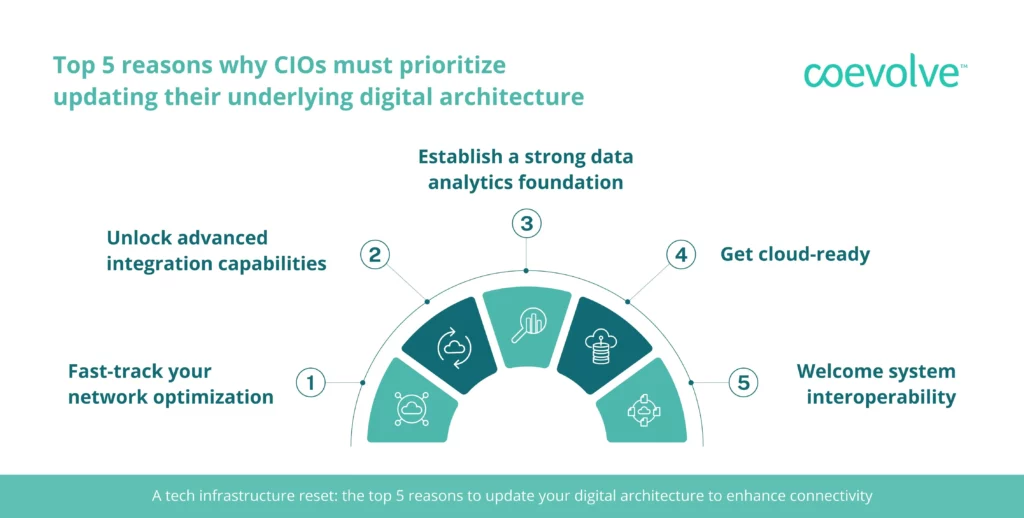
The top 5 reasons why CIOs must modernize their underlying digital architecture
1. Fast-track your network optimization
Business insight: Strategically deployed digital architecture can optimize network performance, reduce latency, and boost bandwidth efficiency, leading to increased communication, productivity, and efficiency.
CIO insight: A stable, high-speed network supports growing connectivity demands while enabling access to next-gen technologies like LEO satellites, 5G, and edge computing.
2. Unlock advanced integration capabilities
Business insight: Benefit from a rapid data exchange by integrating ERP, CRM, and supply chain systems through standardized APIs, shortening data exchange times from hours to seconds, and accelerating decision-making in time-sensitive markets.
CIO insight: Standardizing data flows improves vendor relationship management, streamlines upgrades, and ensures seamless onboarding of new tools – all without causing operational disruptions. Efficiency is also enhanced, and your future-proofing your business processes.
3. Establish a strong data analytics foundation
Business insight: A redesigned digital infrastructure, powered by a modern data lake and real-time analytics tools, allows enterprises to shift from reactive reporting to predictive insights and unlock data-driven decision-making.
CIO insight: Ability to make data-driven decisions that can improve compliance and enable data governance, which will ultimately allow you to justify larger technology investment budgets.
4. Get cloud-ready
Business insight: Enterprise IT infrastructure is the foundation to operate on the cloud successfully, and its transformation prepares enterprises for efficient cloud migration and adoption.
CIO insight: Being cloud-ready allows you to lead a digital transformation, utilize automated orchestration tools to minimize management overhead, align infrastructure costs with business growth, and position IT as a catalyst instead of a cost center.
5. And finally, welcome system interoperability
Business insight: Experience true interoperability, powered by strategic digital architecture, that can reduce operational silos, enabling departments to share data securely and efficiently.
CIO insight: It’s more than a buzzword – interoperability can be tailored to your standards like open APIs to augment IT responsiveness, reduce complexity in vendor portfolios, and guarantee seamless user experiences over various platforms.
Get on your way - embrace the digital future with confidence
In summary, CIOs need to consider a technology reset to future-proof their businesses in the present and near future. Legacy digital infrastructures continue to pose significant challenges for modern enterprises, making it crucial for CIOs to act now.
Our top five reasons for seriously considering a tech reset are just the beginning of what can be achieved with a new IT infrastructure. Although no solution is perfect, rethinking your technology stack can help CIOs and organizations not only meet current network and IT demands but also prepare for future challenges.
Remember, you are not alone in this process. Having a trusted strategic partner with an excellent track record and proven experience can be instrumental during your IT infrastructure transition. Together, we will collaborate to assess and identify opportunities and areas of improvement to strengthen your digital infrastructure, accelerating transformation and ensuring it supports key strategic initiatives effectively. To learn more about Coevolve’s approach, please read our whitepaper or contact us today.