
Navigating Industry 4.0’s Data Deluge: How MSPs Can Unlock Valuable Insights
- Ciaran Roche
The rise of Industry 4.0 technology has sparked a data-driven revolution, generating unprecedented volumes of data and giving leaders more information than they know what to do with. If “data is the new oil,” as mathematician Clive Humby suggests, then manufacturers have the potential to tap into a treasure trove of valuable information to inform more timely and strategic decisions to enhance business performance.
Unfortunately, the World Economic Forum reports that only 39 percent of manufacturing executives have successfully scaled data-driven use cases past the production process of a single product. The challenge lies in learning how to extract and utilize this data effectively. An optimized network infrastructure is key to this.
As it stands, there is no end in sight to the data deluge, so enterprises must get a handle on data management quickly because poor data quality is costing businesses USD$12.9 million a year on average, as reported by Gartner. According to Statista, global data creation is expected to exceed 180 zettabytes by next year— this massive amount of data is comparable to 6.8 billion years of continuous Netflix streaming.
Manufacturing businesses specifically have their work cut out for them as they generate more than 1800 petabytes of data per year and twice as much data as the next closest industry, according to Amazon Web Services. Disruptive trends in the manufacturing sector, such as IoT, machine learning, AI-driven technologies, data and analytics, and hyper-personalization, have exacerbated the data onslaught, generating massive amounts of data to analyze.
Understanding the Industry 4.0 data landscape
CIOs and their teams are struggling to keep their heads above water in the battle to not only analyze data but use it strategically, unlocking new business opportunities, locating vulnerabilities, and optimizing operations. Data management is becoming increasingly complex in the current environment, demanding a robust network infrastructure to support digital transformation.
Internally, CIOs have experienced that the principle of “garbage in, garbage out” is alive and well, and inaccurate data exacerbates this data conundrum, brought on by poor data inputs and a lack of data expertise. According to Gartner, 59 percent of organizations do not measure data quality. Industry experts have reported that anywhere from 60-90 percent of data goes unused, highlighting a crisis caused by excessive data and insufficient time or personnel to analyze it.
From bottlenecks to benefits: unlocking the economic promise of data extraction
This data dilemma has led regions like Europe to take action. With an estimated 80 percent of industrial data in the region going unused, the European Commission introduced the Data Act, supporting businesses with a data framework that sets standards and guidelines for data management. There is also a positive financial aspect to the Act – the Commission forecasts that the new Act will create an additional €270 billion in GDP by 2028.
The hallmark of Industry 4.0 is constant data flow streaming from modern digital tools, triggering network bottlenecks due to inadequate bandwidth, storage, or server overload, highlighting the need for a modern network infrastructure and expertise that can support this network transformation.
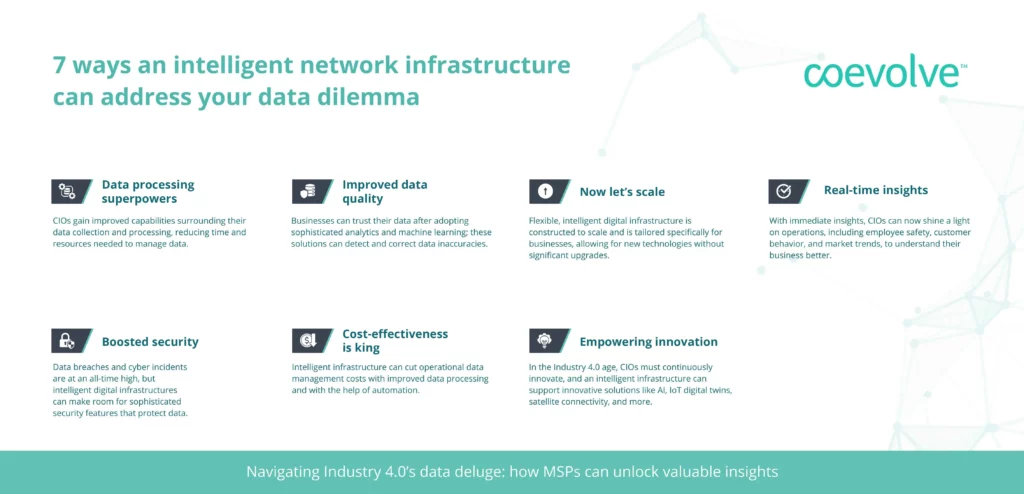
7 ways an intelligent network infrastructure can address your data dilemma
In a digitally dependent world, businesses must work hard to remain competitive and evolve to meet the demands of today. An intelligent network can support businesses progressing through their data journey by unlocking the following:
How one client went from a fragmented to an intelligent IT infrastructure
Manufacturers often face the common challenge of a fragmented IT infrastructure, which can significantly hinder data management, as was the experience for one of our global manufacturing clients who specializes in modular commercial and industrial flooring. This fragmentation was perpetuated by their global reach with offices in several regions: the U.S., Europe, the Middle East and Africa, and the Asia-Pacific area.
All their networks ran in isolation, meaning each location had its own network, including separate Enterprise Resource Planning (ERP) systems and distinct regional security standards. These challenges led to communication barriers and high network costs. They also had an expanded demand for bandwidth to access their critical applications and an increase in cloud services use.
To improve their digital infrastructure, Coevolve’s co-managed methodology enabled our client to optimize their network and security infrastructure to their specific business needs in just under 15 weeks in APAC. Building on the solution’s success in APAC, it was deployed globally, creating a unified global platform. Our client transformed their infrastructure into an intelligent system that supported their international operations while boosting their operational efficiency and security.
The client also now had access to secure, low-cost internet connectivity at every location around the world, were able to balance regional customization with global competitiveness, and had a more scalable, flexible, and capable of achieving their global strategic vision. Lastly, this approach also ensured seamless connectivity and better data management across all regions.
The power of partnership: how to find the right MSP partner
In summary, CIOs need to work smarter, not harder, with the resources that they have available to them. To meet the number of things that a CIO must manage and be accountable for, finding the right-fit managed services provider (MSP) partner can ease your load and support you through your digital transformation journey to get a better handle on your data. They can also expertly guide you so that the journey is both successful and fast-tracked. A trusted partner, such as Coevolve, can future-proof your business and help you make strategic business decisions backed by real-time, accurate data that your intelligent digital infrastructure supports.
When choosing a strategic partner, check to see which business sector they specialize in and review their case studies. Both of these activities can highlight whether a partner is a good or bad fit for your business. Coevolve has deep manufacturing know-how and is well-poised to guide your business with the industry experience required. To learn more about how we can supercharge your data extraction journey through intelligent digital infrastructure, read our recent whitepaper or contact us today.