TESTING Accelerating manufacturing excellence: how to leverage next-gen solutions for Industry 4.0 success
From the era of steam power to the evolution of smart manufacturing, rapid advancements in digital technologies continue to revolutionize the manufacturing sector. However, a combination of legacy IT infrastructure, the introduction of AI and innovative technologies, and massive increases in bandwidth usage are pushing global networks to the edge. To stay ahead of such relentless change, manufacturing enterprises must work faster and smarter with agile thinking and next-generation solutions to build the foundation for Industry 4.0 success.
However, even for the most forward-thinking IT leaders who recognize that their legacy infrastructure can barely keep up with modern digital and connectivity requirements, many struggle with the ‘how.’ According to industry research, 75 percent of manufacturing and engineering businesses are still dependent on legacy infrastructures and spreadsheets to execute tasks, suggesting that it is more challenging than meets the eye to move away from legacy systems. But for those who do make the change and modernize, the upside is certainly there.
Enterprises can unlock boosted bandwidth, cost savings, and enhanced service performance, all of which send this mission-critical message to business leaders: it is no longer a question of “if” but “when” you modernize your infrastructure.
The challenge: the digital revolution is pushing networks to their limits
The smart manufacturing and Industry 4.0 revolution is ushering in a new wave of technology and optimization, as well as complexity. The race to adopt Industry 4.0 will drive significant growth in the global smart manufacturing market. According to Fortune Business Insights, this market is expected to soar in value from approximately USD 349.5 billion in 2024 to nearly USD 999 billion by 2032.
The growth will be sustained by the implementation of cutting-edge technologies such as Big Data, AI, cloud computing, augmented reality and machine learning, which will enable manufacturers to realize better efficiency, data-driven decision-making, and greater scalability. This market is expected to soar in value from approximately USD 349.5 billion in 2024 to nearly USD 999 billion by 2032.
Although the shift from legacy to modern IT infrastructures is critical to advancing digital transformation and ensuring Industry 4.0 success, the increase in smart manufacturing activities continues to significantly impact enterprises, making them increasingly vulnerable to cyberattacks.
The manufacturing sector is a known target of cyber criminals, equating to over a quarter of the global share of manufacturing cyberattacks, with a worldwide average data breach cost reaching over USD 5.5 million. Manufacturing leaders require secure connectivity and IT infrastructure to deploy the best cyber solutions to safeguard their enterprise from breaches but also to ensure various critical issues do not arise, like disruptive downtime and significant data loss.
Traditional telecommunication connectivity is not what it used to be
Previously, manufacturers relied on traditional telecommunication network solutions because they worked. Today, traditional telecommunication strategies are unable to meet the modern connectivity demands of enterprises striving to connect and scale globally, often hindering seamless integration within cloud-based ecosystems of platforms, applications, and users.
A new network approach, combined with a robust digital infrastructure and reliable network connectivity, is needed to not only support smart manufacturing but also power the industry into the future. Without these strategic network and security foundations, costly new integrations will fail.
Forbes has revealed alarming data that 70 percent of digital transformation projects fail, highlighting that before investing in any emerging technology, ensuring your enterprise’s digital backbone is prepped and strengthened is vital.
What does a successful network transformation look like?
For a global leader in paper packaging, producing over 22,000 products across 17 countries and serving clients such as McDonald’s, it became evident that they had a significant IT network infrastructure issue. Their legacy network could not support the new requirements of their expanding global operations.
Recognizing the urgency for change, they understood that modernization was not only a technological necessity but also essential for future-proofing their enterprise. This led them to partner with Coevolve to establish a network that was agile, scalable, and cost-efficient. Together, they implemented a next-generation strategy that included a software-defined WAN (SD-WAN) overlay to replace their outdated MPLS infrastructure. This process involved developing high-level technical architecture, outlining migration paths, and creating detailed commercial models.
A key element in successfully transitioning to smart manufacturing is implementing next-generation solutions like an intelligent overlay. This technology layer enhances connectivity across manufacturing network systems. Additionally, effective convergence of Information Technology (IT) and Operational Technology (OT) drives efficiency and innovation but requires a modern IT infrastructure to overcome security and compatibility challenges.
Lastly, by bridging gaps in legacy infrastructure, an intelligent overlay enables smooth data flow and strengthens digital capabilities, all while supporting a cost-effective transformation to meet the demands of Industry 4.0.
The results of an impactful network modernization journey
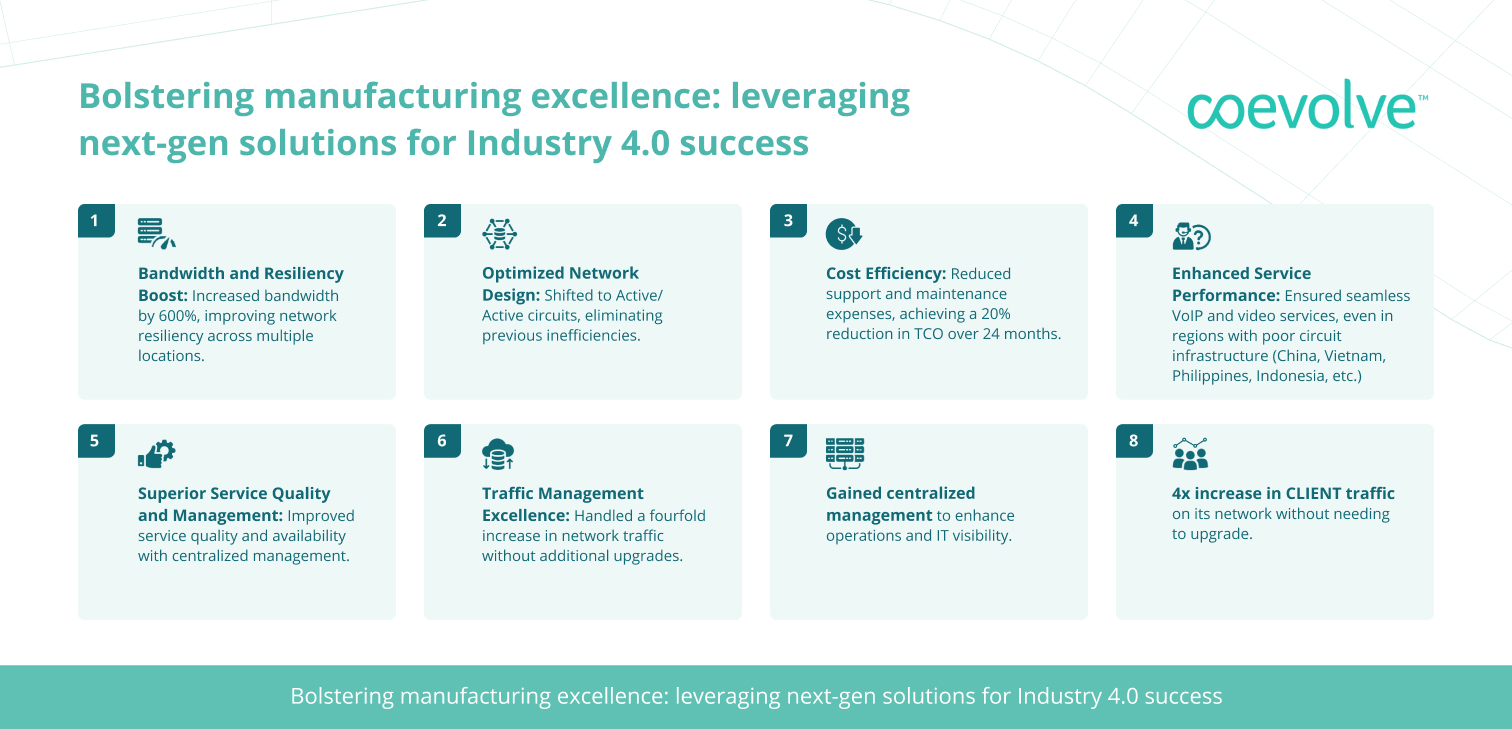
For enterprises that invest in modernizing their networks, there is a huge upside. For instance, the global packaging manufacturer, as an example, not only transformed their networks, but they also transformed their manufacturing operations with the following results:
Boosted bandwith - Achieved a 600% increase, enhancing resilience across location.
Optimizied network design - Transitioned to Active/Active circuits, removing inefficiencies.
Cost savings - Reduced support, maintenance expenses, achieving a 20% reduction in TCO over 24 months.
Enhanced service performance - Ensured seamless VoIP/video services, including poor infrastructure areas.
Superior service quality and management - Enhanced service quality and availability with centralized management.
Traffic management excellence – Seamlessly increased network traffic fourfold without additional upgrades.
After successfully redesigning their network with a scalable, robust network design, the leading manufacturer notably enhanced operations, boosting agility and efficiency.
Modern network solutions for stability and growth
The business outlook is bright when you invest in modernizing your network infrastructure. By updating your digital infrastructure, enterprises can not only keep the lights on, ensuring business operations and systems are operational, but guarantee that you can leverage next-generation solutions and cutting-edge technology in an impactful way to meet enterprise goals. This is especially critical for manufacturers to achieve Industry 4.0 and operational excellence success.
The manufacturing sector is under pressure to transform and under threat of malicious actors, requiring bold action to attain optimized network performance. During this process, enterprises must not lose sight of their transformational end goal, working toward building a new foundation that supports cloud applications and enhances security.
If done well, IT/OT convergence also offers new opportunities for improved operational efficiency and better integration between business and operational technologies. This convergence is a key enabler of its broader objective to build a secure, robust, and future-ready infrastructure, ensuring the company is well-positioned to meet the demands of an increasingly digital and interconnected world.
To learn more about Coevolve or our transformative digital approach, please visit or contact us.